If you own rental property in Milwaukee — or you're eyeing a deal here — one of the first questions you'll run into is: How much does property management actually cost?
It seems straightforward. But the more you shop around, the more confusing it gets. One company advertises 5%. Another quotes 10%. Someone else pitches a flat $99/month. And then there are leasing fees, maintenance markups, renewal charges, and a dozen other line items buried in the management agreement.
As Managing Director of Residential Renters, I've worked with dozens of property management companies throughout Greater Milwaukee. Through our tenant placement network, we've seen firsthand what separates great management from the rest — and what pricing models actually deliver for owners. So let me break down what the Milwaukee market actually looks like, what the different pricing models mean in practice, and — most importantly — what you should really be comparing when you're evaluating property managers.
The Milwaukee Pricing Landscape
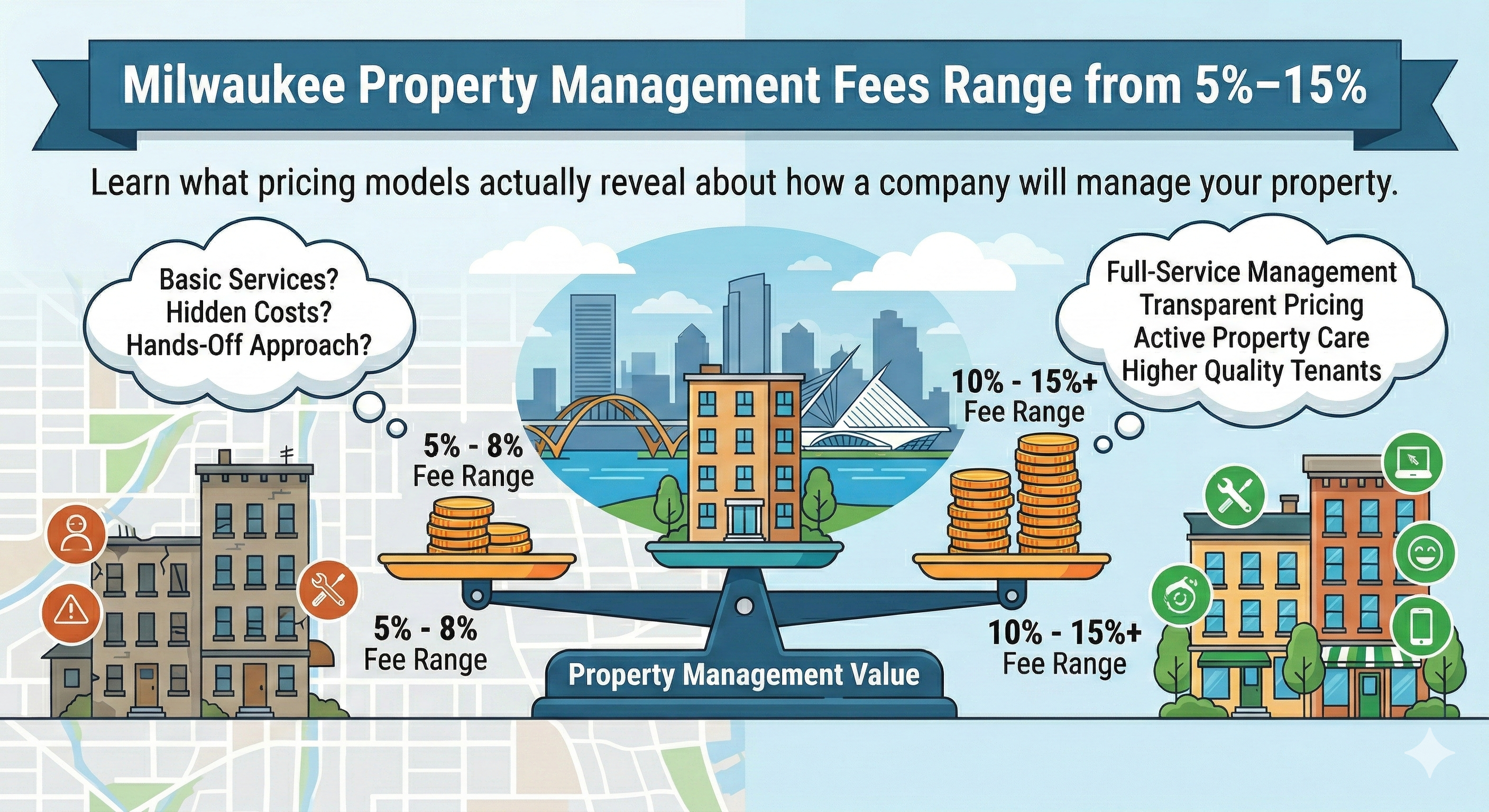
Most professional property management companies in Milwaukee charge somewhere between 5% and 15% of monthly rent collected. The sweet spot for full-service management tends to land in the 8%–10% range.
Here's the general breakdown:
- Lower end (5%–7%): Usually high-volume shops managing large door counts. Service can be more standardized, less personalized.
- Mid-range (8%–10%): Full-service firms handling leasing, maintenance coordination, rent collection, compliance, and renewals with more hands-on attention.
- Upper end (10%–15%): Smaller boutique firms or higher-touch models, sometimes managing fewer doors with more white-glove service.
On the tenant placement side, many companies charge up to one full month's rent as a leasing fee. That number can feel steep — until you consider what a bad placement actually costs you (more on that below).
Flat Fee vs. Percentage: Two Very Different Philosophies
When you strip away the marketing, most PM pricing falls into one of two structures:
Flat Monthly Fee
A fixed dollar amount per property — say $125 or $150/month — regardless of what the unit rents for.
The appeal: It's simple. Predictable. Easy to budget.
Percentage of Gross Collected Rent
The fee is tied directly to what actually comes in the door each month — typically 8%–10% of rent collected.
The appeal: The manager only earns when you earn. Their revenue is linked to your property's performance.
Neither model is inherently bad. But they create very different incentives inside the company — and that's what most owners miss.
Why Incentive Alignment Matters More Than the Rate
Property management is really a series of key performance events:
- Tenant placement — Finding and screening the right renter
- Rent collection — Making sure income actually hits your account
- Maintenance coordination — Protecting the asset without overspending
- Tenant renewals — Retaining good tenants and avoiding turnover costs
- Vacancy control — Minimizing income gaps between tenants
- Compliance management — Staying on the right side of local and state law
Each of those moments has a direct financial impact on you as the owner. The question worth asking is: Does the pricing model reward the company for excelling at those moments — or does it reward them regardless?
Here's the tension with flat-fee models. If a company charges $150/month per unit whether the rent is $1,000 or $1,800, their revenue per property is locked. But their costs aren't. Over time, as expenses rise and revenue stays flat, the company has to respond somehow:
- Increase door count to make up revenue
- Reduce service depth per property
- Standardize to the lowest common denominator
- Overload staff with more units than they can handle well
The result? Slower response times. Weaker screening. Missed maintenance details. Higher tenant turnover. And you, the owner, absorb all of that cost — even though you thought you were saving money on management fees.
With a percentage-of-collected-rent model, the incentives naturally align:
- If rent isn't collected, the manager doesn't get paid — direct accountability.
- If the property sits vacant, the manager is motivated to lease it correctly and quickly.
- If the market supports a rent increase, both sides benefit.
- The structure scales naturally with the property's performance.
Having placed tenants for many different management companies across Greater Milwaukee, I've seen this play out over and over. The firms that use a percentage-of-collected-rent model tend to stay sharper — they have skin in the game on every unit, every month. One company we've had consistently strong results with is Safe House Property Management, which starts at 8% of gross collected rent. It's a structure that keeps everyone rowing in the same direction — and in our experience, that accountability shows up in the day-to-day operations.
Tenant Placement: Where Under-Investing Hurts the Most
Let's talk about the leasing fee — because this is the one line item where owners most often try to cut corners, and it's the one that costs the most when it goes wrong.
A bad tenant can mean:
- Months of lost rent during an eviction process
- Legal fees that stack up fast, especially in Wisconsin
- Property damage that eats into (or wipes out) your returns
- Stress and time you didn't budget for
One poor placement can easily cost $5,000–$10,000+ when you add it all up. Compare that to paying a full month's rent for a thorough screening, professional showing process, and a qualified tenant who stays and pays.
The leasing fee isn't where you want to bargain hunt. It's where you want the best work done.
What Owners Should Actually Compare
When you're shopping property managers in Milwaukee, don't just compare the percentage or the flat fee. Compare these:
- How is the fee structured — bundled or itemized? This is one of the most important questions owners overlook. Some companies roll everything into a single management percentage. On the surface that feels simple — but it can have unintended consequences. When every service is buried inside one fee, there's no clear performance incentive tied to critical events like lease renewals, inspections, or maintenance coordination. If the company gets paid the same whether they complete a thorough annual inspection or skip it entirely, what's driving accountability at that moment?
Separate, transparent pricing for key services means two things for you as an owner:
(1) you can see exactly what work was done and what you paid for it, and
(2) the management company has a direct incentive to perform at every stage — because their compensation is tied to the execution. You want your property manager motivated to renew a good tenant, not indifferent to whether they stay or go. Clear itemized charges create that alignment. The "everything included" pitch sounds appealing, but costs don't disappear just because they're hidden inside a percentage. They either show up as reduced service quality or get absorbed by the company until they can't sustain it — and then they surface as negligence at the moments that matter most.
- How do they handle vacancy? Do they charge during vacancy? Are they incentivized to fill units quickly — and correctly?
- What does their screening process look like? A rigorous process upfront saves thousands on the back end.
- How are maintenance requests handled? Is there an in-house team? Preferred vendors? Markup on repairs?
- What's the communication cadence? Monthly owner statements? A portal? Someone who actually picks up the phone?
- What's their tenant retention rate? Renewals are cheaper than turnovers. Always.
The cheapest management fee almost never produces the cheapest total cost of ownership. And the most expensive fee doesn't guarantee the best service. Look at the structure. Look at the incentives. Look at the results.
The Bottom Line
Property management in Milwaukee ranges from roughly 5% to 15% of rent collected, with most full-service firms in the 8%–10% range. Flat fees and percentage fees each have tradeoffs — but the real difference is in how the pricing structure aligns (or doesn't) with the outcomes you care about.
Through Residential Renters, we've worked with property management companies across the spectrum — from large-volume shops to boutique operators. The companies that consistently deliver for owners tend to share a few things in common: percentage-based pricing that keeps them accountable, selective tenant screening, and a team that's big enough to be responsive but small enough to actually know your property.
One company that checks those boxes, in our experience, is Safe House Property Management. They're not the cheapest option in Milwaukee — and that's intentional. They're selective about who they work with, which means they can maintain the service quality that keeps owners coming back. They're not the right fit for everyone, but for owners who value accountability and hands-on management, they've been the strongest operator we've partnered with in Greater Milwaukee.
If you're exploring property management in Milwaukee and want to talk through what might make sense for your situation, I'm always happy to chat —
~Ben Jacobs
Residential Renters